
Employment Contract Types in Italy
For foreign nationals entering the Italian labor market, understanding the structure of employment contracts is essential. Italian labor law is governed by the Civil Code, specific legislative decrees (such as the Jobs Act and the Dignity Decree), and National Collective Labour Agreements (Contratti Collettivi Nazionali di Lavoro or CCNL). These agreements vary by industry and determine specific rights regarding wages, working hours, and benefits.
In Italy, an employment contract must generally be provided in writing. It serves as the legal basis for obtaining or renewing a residence permit (permesso di soggiorno) for work purposes. Every contract must be communicated to the National Social Security Institute (INPS) and the Ministry of Labour through a mandatory communication form known as "UNILAV."

Permanent Employment Contract (Contratto a Tempo Indeterminato)
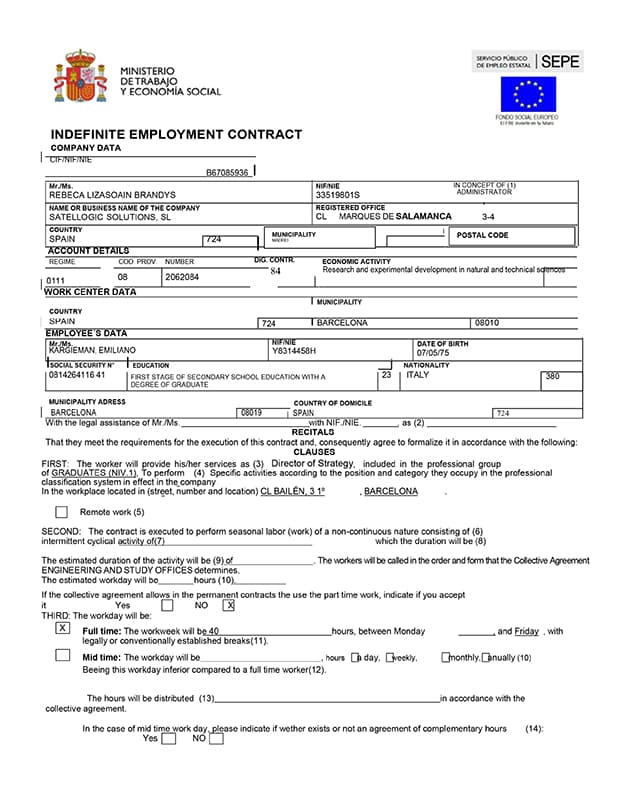
The Contratto a Tempo Indeterminato is the standard form of employment in Italy. It has no expiration date and provides the highest level of job security and social protections. Since March 2015, most new permanent contracts fall under the "increasing protections" (tutele crescenti) regime, which regulates compensation in case of unfair dismissal.
- Stability: It is the preferred contract for long-term residency and mortgage applications.
- Benefits: Includes paid annual leave, sick leave, maternity/paternity leave, and the 13th-month salary (and sometimes 14th-month, depending on the CCNL).
- Termination: Requires a notice period unless there is "just cause."
Fixed-Term Employment Contract (Contratto a Tempo Determinato)
A Contratto a Tempo Determinato has a specific end date. Under current 2025/2026 regulations, these contracts are subject to strict limitations to prevent the precarious use of temporary labor.
Key rules for fixed-term contracts include:
- Maximum Duration: Generally, the total duration with the same employer for the same tasks cannot exceed 24 months, including extensions.
- Causal (Reasons): A contract can be signed for up to 12 months without specifying a reason. Beyond 12 months (up to 24), a specific legal, technical, or organizational reason must be cited, as defined by the CCNL.
- Extensions and Renewals: Extensions happen before the original end date; renewals happen after the contract has expired. Renewals usually require a "cooling-off" period between contracts.
Apprenticeship Contract (Apprendistato)
The Apprendistato is a "mixed-cause" contract designed for young people. It combines work with formal training. It is considered a permanent contract from the start, though the employer can terminate it at the end of the training period with proper notice.
There are three main types:
- Professional Apprenticeship: For individuals aged 18 to 29, aimed at learning a specific trade or profession.
- High Education and Research Apprenticeship: For those aged 18 to 29 working towards a degree, PhD, or professional qualification.
- Vocational Qualification: For minors (15+) and young adults to obtain a professional diploma.
Employers favor this contract because they pay lower social security contributions. For the employee, the salary may be slightly lower (usually two levels below the final qualification level), but it includes full social security rights.

Intermittent or On-Call Work (Lavoro Intermittente)
Also known as "Job on Call," this contract allows an employer to call an employee only when needed. It is common in the hospitality and tourism sectors. This contract can be used for workers under 24 years of age or over 55. If the worker remains at the employer's disposal even when not working, they may be entitled to an "availability allowance."
Seasonal Contracts (Contratto Stagionale)
Seasonal contracts are used for activities that occur only during specific times of the year, such as agriculture or summer/winter tourism. These contracts do not follow the strict 24-month limit applied to standard fixed-term contracts and are often used by non-EU workers entering Italy via the annual "Flow Decree" (Decreto Flussi).
Self-Employment and Collaboration
While not "employment contracts" in the subordinate sense, many foreigners work under these arrangements:
Coordinated and Continuous Collaboration (Co.co.co)
The Collaborazione Coordinata e Continuativa is a hybrid between subordinate employment and self-employment. The worker manages their own time but operates within the employer's organization. They are paid via a "payslip" (busta paga) but do not have the same protections as standard employees regarding dismissal or leave.
VAT Number (Partita IVA)
This is for truly independent professionals. The worker is responsible for their own taxes and social security contributions.
Note: If a Partita IVA holder works exclusively for one client, at the client's premises, using the client's equipment, Italian law may "re-qualify" this as a subordinate employment contract.
Essential Contractual Clauses
Regardless of the type, every Italian employment contract must specify:
- Trial Period (Periodo di Prova): A duration where either party can terminate the contract without notice. The maximum length is determined by the CCNL and the job level.
- Place of Work: The specific office or site.
- Job Title and Level: Based on the professional classification in the CCNL.
- Remuneration: The gross annual salary (RAL). For example, a minimum entry-level salary in the retail sector might be approximately 21,000 EUR ($22,050 USD, Jan 2026) per year.
- Working Hours: Full-time is typically 40 hours per week.
Practical Steps for Foreigners
Before signing, foreign nationals should verify that the contract matches the requirements for their specific visa or residence permit. For example, a "Permesso di Soggiorno per Motivi di Studio" allows for a maximum of 20 hours of work per week. For more detailed information on labor rights, individuals can contact the Ministry of Labour and Social Policies or a local "Patronato" (social assistance office).
Exceptions and Special Cases
Certain highly skilled workers (Blue Card holders) or intra-corporate transferees may have different contractual requirements and simplified administrative procedures. Similarly, domestic workers (caregivers and housekeepers) follow a specific National Collective Agreement that differs significantly from corporate labor laws regarding notice periods and termination.