
Overview of the Italian University Application System
Applying to a Higher Education Institution (HEI) in Italy involves a multi-step process that varies depending on the applicant's citizenship and place of residence. The Italian system differentiates primarily between European Union (EU) citizens and non-EU citizens residing abroad. For the 2025/2026 academic year, the process is centralized through digital platforms but requires physical documentation for final validation.
Higher education in Italy is provided by universities and the AFAM system (Higher Education in Art, Music, and Dance). Each institution has the autonomy to set specific admission criteria, but they must all follow the general ministerial guidelines published annually by the Ministry of University and Research (MUR).
Applicant Categories and General Requirements
The administrative path depends on which of the following categories the student falls into:
- EU Citizens and Equivalent: Includes citizens of the European Union, Norway, Iceland, Liechtenstein, Switzerland, and non-EU citizens already holding a long-term Italian residence permit (Permesso di Soggiorno). These applicants apply directly to the university.
- Non-EU Citizens Residing Abroad: These applicants must undergo a mandatory pre-enrollment process through the Universitaly portal and apply for a Type D National Visa for study purposes.
All applicants must possess a secondary school diploma obtained after at least 12 years of schooling to access Bachelor’s degrees (Laurea), or a relevant Bachelor’s degree to access Master’s degrees (Laurea Magistrale).
The Application Phases
Step 1: Pre-evaluation and Admission Tests
Many Italian universities require a "Pre-evaluation" phase where students submit their transcripts online to check eligibility. Following this, students may need to take admission exams. These can be local (set by the university) or national (set by the Ministry). Common exams include:
- TOLC (Test Online CISIA): Used for many English and Italian-taught programs in economics, engineering, and science.
- IMAT (International Medical Admissions Test): For English-taught Medicine and Surgery programs.
- Architectural Studies Test: A mandatory national exam for architecture degrees.
Step 2: The Universitaly Pre-enrollment
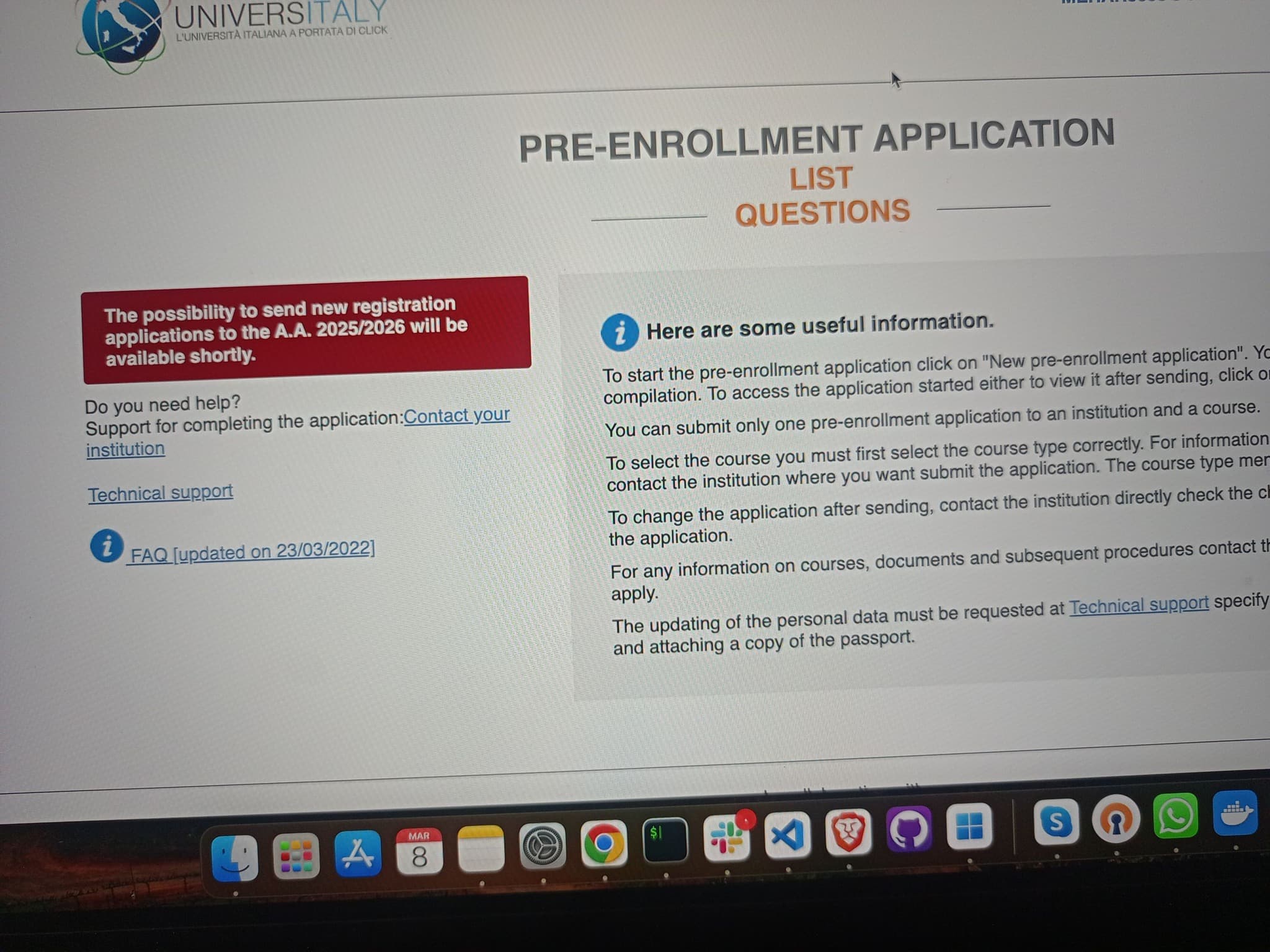
Non-EU students residing abroad must register on the Universitaly Portal. This is the official gateway for the 2025/2026 academic year. During this phase, the applicant selects the chosen university and program. The university then validates the application online, which is a prerequisite for the visa interview at the Italian Embassy or Consulate.
Step 3: Administrative Enrollment
Once the student arrives in Italy or receives admission, they must complete the formal enrollment (immatricolazione) by paying the first installment of tuition fees and the regional tax, which is typically around 140 EUR ($152 USD, Jan 2026) to 160 EUR ($174 USD, Jan 2026), depending on the region.
Required Documentation
Documents not issued in Italian or English generally require a certified translation. For the 2025/2026 cycle, the following documents are standard:
Academic Records
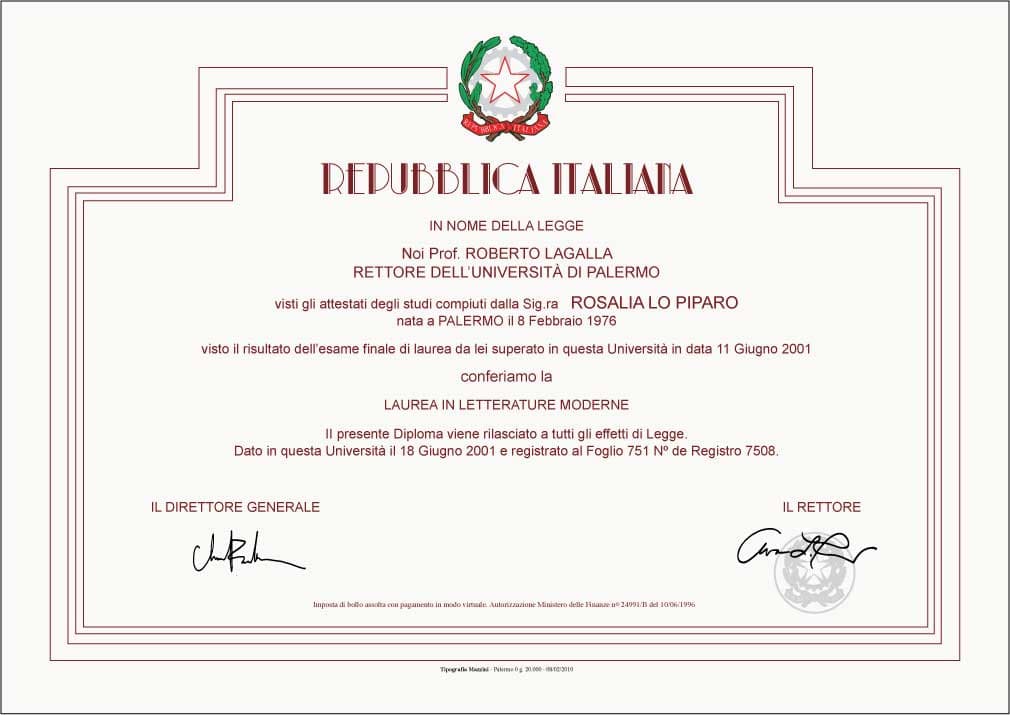
- Final Diploma/Degree: The original certificate or a certified copy.
- Transcript of Records: A detailed list of exams passed and grades achieved.
- Syllabus: For Master's applicants, a description of the courses taken during their Bachelor's degree may be required.
Legalization and Validation
To confirm the validity of foreign qualifications, the Italian authorities require one of the following:
- Declaration of Value (Dichiarazione di Valore): Issued by the Italian Embassy in the country where the qualification was awarded.
- CIMEA Statements: Many universities now accept the Statement of Comparability and the Statement of Verification issued by CIMEA. These are digital certificates that replace the Declaration of Value. The cost for a Statement of Comparability is approximately 150 EUR ($163 USD, Jan 2026).
- Apostille: For countries that are members of the Hague Convention, documents must bear an Apostille stamp.
Language Proficiency
Applicants must prove they can follow courses in the language of instruction:
- Italian-taught programs: Usually requires a B2 level certificate (CILS, CELI, PLIDA, or Roma Tre).
- English-taught programs: Usually requires IELTS (typically 6.0 or 6.5), TOEFL iBT, or equivalent. Some universities waive this if the previous degree was taught entirely in English.
Deadlines and Costs
Deadlines are strict and vary by institution. However, the general timeline for 2025/2026 is as follows:
- University Applications: Often open between January and April 2025.
- Universitaly Pre-enrollment: Generally opens in March 2025 and closes between June and July 2025.
- Visa Application: Should be completed by late August 2025 to ensure arrival for the start of the semester in September/October.
Application fees for individual universities vary from 30 EUR ($33 USD, Jan 2026) to 100 EUR ($109 USD, Jan 2026). Note that these fees are non-refundable regardless of the admission outcome.
Exceptions and Special Cases
Non-EU students already residing in Italy with a valid permit for work or family reasons do not need to follow the Universitaly pre-enrollment for visa purposes; they follow the same procedure as EU citizens.
UK citizens fall under non-EU rules following Brexit, unless they were residents in Italy before December 31, 2020, and hold the "Carta di Soggiorno Elettronica" under the Withdrawal Agreement.
For refugees and beneficiaries of subsidiary protection, the process may involve the "European Qualifications Passport for Refugees" (EQPR) if original documentation is unavailable. This is a specialized path coordinated by the Council of Europe and CIMEA.