
Integration and Language in Italy: A Guide for Foreigners
For foreign nationals residing in Italy, integration is not merely a social concept but a formal administrative process regulated by law. The Italian state links the renewal of residence permits and the acquisition of long-term status to specific benchmarks in language proficiency and civic knowledge. Understanding the Integration Agreement and the recognized language certifications is essential for securing a stable legal status in the country.
The Integration Agreement (Accordo di Integrazione)
Non-EU citizens who enter Italy for the first time and apply for a residence permit valid for at least one year must sign the "Integration Agreement" with the state. This is a legally binding contract between the foreigner and the Italian government.
How It Works
Upon applying for the residence permit at the Sportello Unico per l'Immigrazione (Single Desk for Immigration) or the Questura, the applicant signs the agreement. The system operates on credits:
- Initial Credits: The signer is assigned 16 credits upon signature.
- Goal: Within two years (extendable to three), the signer must reach a total of 30 credits.
- Requirements to Gain Credits:
- Acquiring an A2 level knowledge of the Italian language.
- Understanding the fundamental principles of the Italian Constitution and civic organization.
- Fulfilling compulsory education obligations for minor children.
- Registering with the National Health Service (SSN).
- Credit Deductions: Credits are deducted for criminal convictions or administrative fines.
Failure to meet the credit requirements can technically result in the revocation of the residence permit or denial of its renewal, leading to expulsion, although exemptions exist for refugees and those with serious health issues.
Language Proficiency Levels and Legal Requirements
Italian law mandates different levels of language competence depending on the type of immigration status being sought. These levels follow the Common European Framework of Reference for Languages (CEFR).
Level A2: For Long-Term Residence
To obtain the EU Long-Term Residence Permit (Permesso di soggiorno UE per soggiornanti di lungo periodo), formerly known as the "Carta di Soggiorno," applicants must prove proficiency at the A2 level. This level indicates an ability to communicate in simple, routine tasks.
Level B1: For Citizenship
Under the security decree (Law 132/2018), applicants for Italian Citizenship (by marriage or residency) must certify proficiency at the B1 level. This is a higher standard, requiring the ability to understand main points of clear standard input and handle most situations likely to arise while traveling.
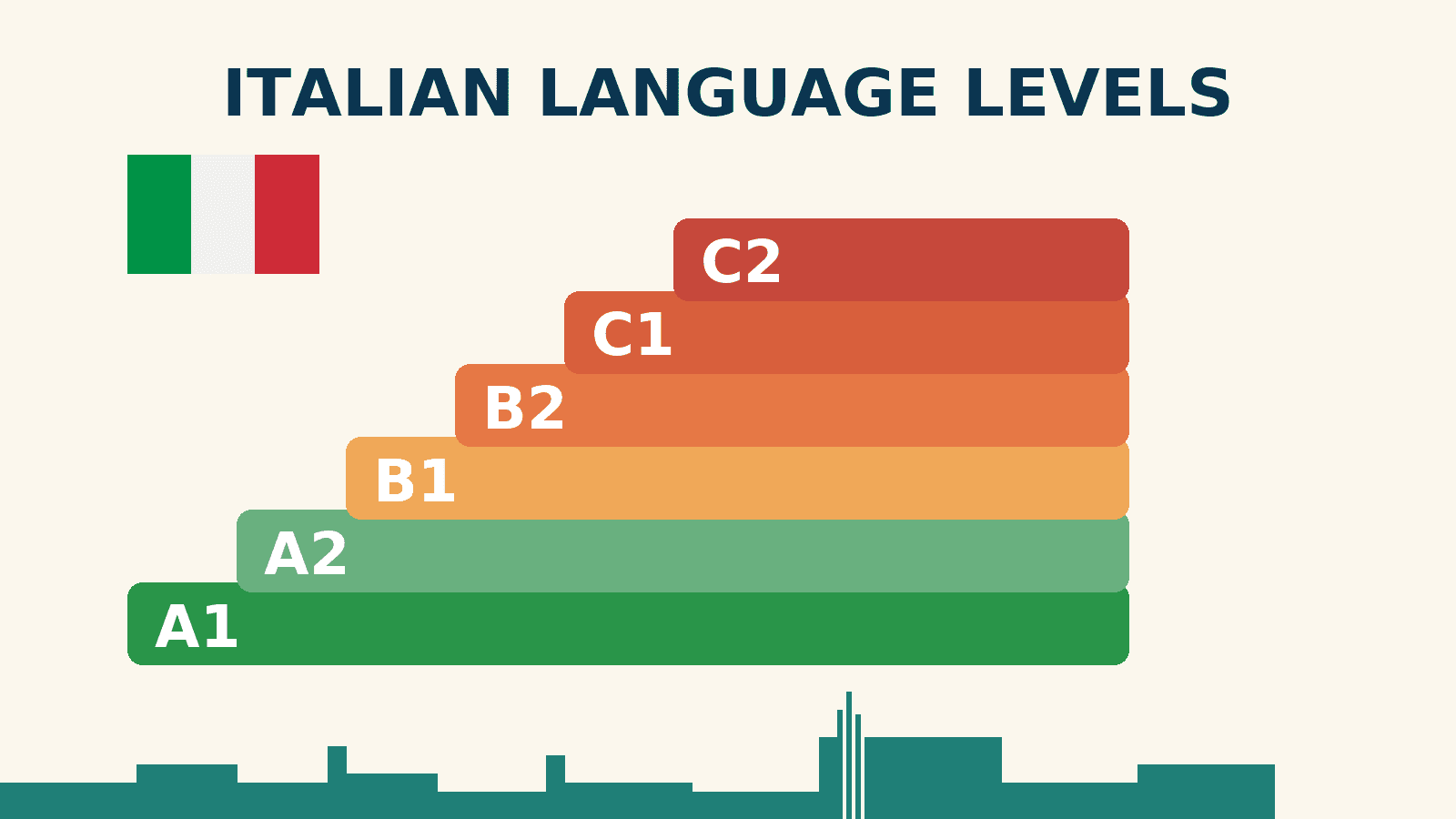
[Image placeholder: A chart comparing CEFR levels A1, A2, B1, B2 with the corresponding Italian legal requirements for permits and citizenship]Recognized Language Certifications
Not all language diplomas are accepted by the Ministry of Interior. For legal purposes (residency or citizenship), the certificate must be issued by one of the bodies belonging to the CLIQ association (Certificazione Lingua Italiana di Qualità). These include:
- CILS (University of Siena)
- CELI (University for Foreigners of Perugia)
- PLIDA (Dante Alighieri Society)
- CERT.IT (Roma Tre University)
Cost of Exams: Fees vary by center and level but typically range from €40 to €150 (~$43 to ~$162 USD). Registration usually closes 40 days before the exam date.
CPIA: Public Adult Education Centers
The Centri Provinciali per l'Istruzione degli Adulti (CPIA) are public schools managed by the Ministry of Education, specifically designed for adult education. They are the primary resource for foreigners needing to fulfill the Integration Agreement.
- Courses Offered: Italian language (L2) from illiteracy to B1 level, and lower secondary education (middle school diploma).
- Cost: Courses are generally free or require a nominal administrative fee (approx. €20 – €30 per year / ~$21 – $32 USD).
- Certification: Passing a CPIA course and the final exam grants an official attestation of A2 level proficiency, valid for the long-term residence permit (but not always sufficient for the B1 citizenship requirement, which often requires a CLIQ certificate).
Cultural Norms and Civic Expectations
Integrating into daily life involves navigating unwritten social rules. While these are not enforced by law, observing them facilitates social acceptance.
Formal vs. Informal Address
Italian distinguishes between the formal "Lei" and the informal "Tu."
Usage: It is standard practice to address strangers, elderly people, and officials (police, doctors, clerks) with "Lei" and the title "Signore" or "Signora." Moving to "Tu" is typically invited by the senior or superior party.
Quiet Hours (Orario di Riposo)
Many condominiums and municipalities enforce quiet hours, typically from 1:00 PM to 4:00 PM and after 10:00 PM. During these times, loud noises such as drilling, lawn mowing, or loud music are prohibited or socially unacceptable.